


Thermal field components need to maintain:
- Stable high-temperature performance
- Better structural reliability
- Improved energy efficiency
C/C composites have become an important material solution for these challenges.
1. Stronger Structure for Larger Thermal Field Components
As crystal growth equipment increases in size, thermal field components face higher mechanical and thermal stress.
Compared with conventional materials, C/C composites combine carbon fiber reinforcement with a carbon matrix, providing higher strength and improved fracture resistance.
Key advantages:
✓ Higher mechanical strength
✓ Better resistance to cracking and chipping
✓ Improved reliability during operation and maintenanceC/C composites typically achieve flexural strengths of 130–150 MPa, significantly higher than commonly used isostatic graphite materials.
2. Better Thermal Management and Energy Efficiency
Thermal control is critical during silicon crystal growth.
The lower through-thickness thermal conductivity of C/C composites helps reduce unnecessary heat transfer and improve thermal insulation performance.
Benefits include:
- Reduced heat loss
- More stable thermal fields
- Lower furnace energy consumption
The through-thickness thermal conductivity of C/C composites is below 30 W/(m·K), compared with approximately 80–120 W/(m·K) for graphite.
3. Design Flexibility for Advanced Thermal Field Systems
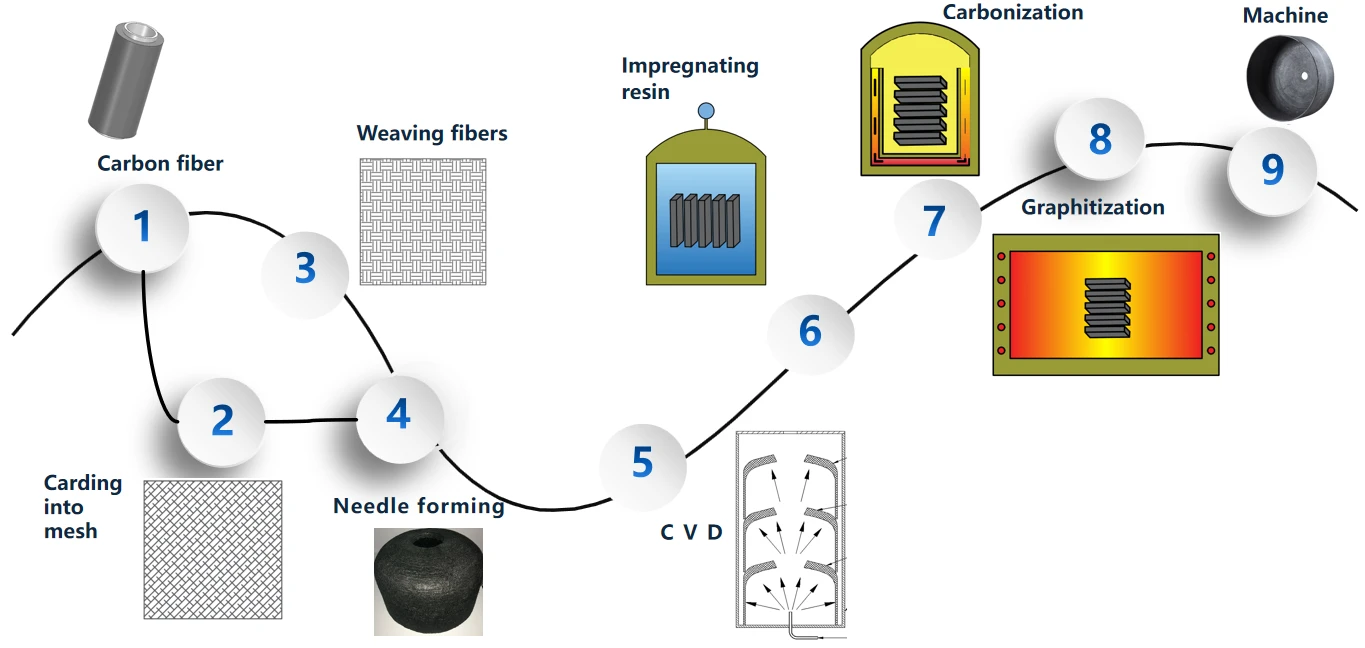
As thermal field structures become larger and more complex, material design flexibility becomes increasingly important.
C/C composites can be manufactured into:
- Large-size components
- Thin-wall structures
- Customized geometries
Through composite processing technologies, C/C parts can achieve integrated structures with fewer joints and improved overall performance.
4. Faster Thermal Response and Improved Process Efficiency
Compared with traditional materials, C/C components have lower density and lower thermal inertia.
This allows thermal field systems to respond faster during heating and cooling cycles.
Typical C/C composites used in photovoltaic applications have a density of 1.3–1.4 g/cm³, lower than graphite at approximately 1.7–1.9 g/cm³.
5.Supporting the Future of Photovoltaic Manufacturing
As photovoltaic manufacturing continues to pursue larger wafer sizes, higher efficiency, and lower energy consumption, material performance becomes increasingly important.
With excellent mechanical strength, thermal stability, and design flexibility, carbon/carbon composites provide reliable solutions for advanced photovoltaic thermal field applications.